This is my second song to tab from the Million Dollar Hotel soundtrack. (The first was "Satellite of Love," a Lou Reed song, of course, but with a different arrangement.) Since tabbing "Satellite," I finally watched the movie. Its opening five minutes are stunning: a crack-of-dawn helicopter shot of downtown LA (accompanied by "The First Time"—U2 at their most Velvety), culminating in the happiest suicide imaginable, a dive off the eponymous hotel with one hell of a view on the way down. Sadly, nothing else in the film comes close to being that good. I'm sorry to report that The Million Dollar Hotel is a barely coherent, unfunny mess. It stars Jeremy Davies, one of the most mannered actors in the world, at his mannered worst. Moreover, that soundtrack, which I'd absorbed over the past decade and half, does not set the mood as I'd thought it would. Much of the music in the film is unfamiliar, and some pieces from the album never seem to show up. In other words, the movie, for me, was kind of a bust.
Ah well. The music remains great, including this sultry ballad, which gives us an idea of what Bono-the-solo-artist might sound like. Joined by that crack MDH Band of Jon Hassell, Bill Frisell, et al, it evokes for me mid-70s Bowie songs like "Win" and "Wild Is the Wind." (Bowie is at the root of a lot of U2's music.) As with the MDH version of "Satellite," I appear to be the only human on the Web who has bothered to tab this thing. (Almost forgot—you'll want to listen to the song, of course.)
NEVER LET ME GO
(Bono/The MDH Band)
Intro
e------------------------
b------------------------
g------------------------
d---------------0-2----
a-4-0-------2------2--
e-----3-2-0----------0-
Em
You take a stranger by the hand
A man who doesn't understand
His wildest dreams
Em
You walk across the dirty sand
And offer him an ocean
Of what he's never seen
G
Maybe I was blind
F#m
Or I, I might have closed my eyes
G
Maybe I was dumb
But what I forgot to say
F#m
If you didn't know
Em
Is never let me go
A
Never let me go
Em
Never let me go
A
Never let me go
e-------------------------
b-------------------------
g-4-2-0-----------------
d--------4-2-----0-2----
a---------------2-------2--
e-------------0----------0-
You run from love and don't believe
Unless it catches you by the heel
That even then, you struggle
From red I learned to cross the strand
Your footprints still there in the sand
Everything else, washed away
I may not be alone
Oh I, I may have found my home
I may have lost my way
But what I forgot to say
If you didn't know
Is never let me go
Never let me go
Never let me go
Saturday, April 19, 2014
Monday, February 18, 2013
Shameless Bid for Blog Traffic
In a crass attempt to attract visitors, I am pasting the link to a stream of the new Atoms for Peace album, AMOK, into this blog post. The AMOK web page has a so-called visualizer—and, reports Pitchfork: "Any site that has the link http://amok.atomsforpeace.info/ posted automatically gets added to the visualizer, which cycles through the sites randomly."
I feel compelled to point out that I am also a fan. I also feel compelled to point that a.) rather than the advertised "visualizer," the link appears to bring one to a black web page with neither text nor links, necessitating one to access the stream through the Flash player on the Pitchfork page, and that b.) having listened to the stream, I think the new album exposes Yorke's David Byrne fixation rather neatly. (He once seemed to wish he'd created the White Album; I now think he wishes he'd made Remain in Light.) Of course, the music also resembles The Eraser, not to mention the last Radiohead release, King of Limbs, a record which—like Talking Heads' Naked—was a conspicuous fall from previous heights, as each band gamely followed its respective frontman down a new and, I'm sorry, less fruitful path.
Tuesday, October 16, 2012
Hey everybody, meet my new friend--Carolina Jones
Email I received earlier today from Lithuania:
How are you? I'm Carolina, I want us to become friends so that I can share my life privacy with you & send you my pictures. I hope to see your mail take good care of your self.
Yours,
Caro
How are you? I'm Carolina, I want us to become friends so that I can share my life privacy with you & send you my pictures. I hope to see your mail take good care of your self.
Yours,
Caro
Saturday, September 15, 2012
An Only Child
Ten things—besides that five-string open-G tuning everybody mentions—that I learned from Keith Richards' memoir, Life.
1. Both his father and stepfather are called Richards. Keith doesn't seem to be impressed by the coincidence (if that's what it is). His mother was from a family of seven daughters, and if you've ever wondered about the hardiness of Keith's constitution, you should know that most of his aunts are still alive.
2. London streets used to be full of animals. Keith: "When I was growing up, it was heavy fog almost all winter, and if you've got two or three miles to walk to get back home, it was the dogs that led you. Suddenly old Dodger would show up with a patch on his eye, and you could basically guide your way home by that. Sometimes the fog was so thick you couldn't see a thing. And old Dodger would take you up and hand you over to some Labrador. Animals were in the street, something that's disappeared. I would have got lost and died without some help from my canine friends." (The roughly 60 pages of childhood stuff is probably the book's high point. Effortlessly evocative, it reads at times like some long-lost Dickens narrative, with asylum escapees on the heath, army deserters hiding in the woods by the Thames, a dead tramp found covered in bluebottles, street bullies, even a fatal explosion at a fireworks factory. He sometimes took a shortcut behind the factories and paper mill, past an "evil-smelling creek": "every chemical in the world had been poured into this creek, and it's steaming like hot sulfur springs. I held my breath and walked quicker. It really looked like something out of hell.")
3. Had a mouse and a cat for pets. The mouse went to school with him in his pocket. His mother had the cat put to sleep, and Keith shoved a drawing of a cat under her door with the word "murderer" written beneath it.
4. The winter that Keith, Mick, and Brian Jones shared a flat was London's coldest since 1740. The flat had a pay heater—they had to keep feeding it coins.
5. Keith not only wrote the bulk of the music for most of their best songs; he often came up with the lyrical angle as well: "Satisfaction," "Gimme Shelter," "Wild Horses" (I could go on) are all concepts that Jagger simply (albeit brilliantly) expanded on.
6. While Mick was fooling around with Anita Pallenberg on the set of Performance, Keith had revenge sex with Marianne Faithfull (and fled through a window when Mick came home). I've thought of Mick and Keith's friendship as fairly up and down, but the best way to describe it, for thirty years now, would be simply nonexistent. Interestingly, there are more entries in the index for Mick Jagger than there are for Keith himself. (My favorite: "Jagger, Mick and giant inflatable cock, 12-13, 485").
7. In the late '60s in the UK, if your physician registered you with National Health as a junkie, you could receive heroin pills plus an equal amount of cocaine (the idea being that the coke would counteract the opiate effect of the heroin). This was the purest heroin and the purest, May & Baker pharmaceutical cocaine. Definitely no MSS (that is, Mexican shoe scrapings—Gram Parson's term for low-grade street smack).
8. Injuries sustained: finger squashed when he dropped a flagstone on it, earring ripped from his ear as he slept, passing out after nine days without sleep and falling headfirst into an amplifier, finger burned to the bone by stray lump of phosphorous from stage pyro, punctured lung (after falling off ladder), cracked skull (falling from tree).
9. When I was fourteen I found an old copy of Oui magazine in, of all places, a deer blind in the hill country of Texas. ("For the man of the world"—yeah, that was me all right.) One of the models was a dark-haired German who, in one memorable shot, drank water from a see-through garden hose. And now, all these years later I find out her name is Uschi Obermaier, a long-standing crush of Keith's. When he learned of Gram Parsons' death in '73 he was in Innsbruck; on a mad impulse he drove to Munich in the middle of the night to hunt Uschi down, although he barely knew her. He miraculously found her, woke her up, broke the news, got a single sleepy kiss for his trouble, and left.
10. Towards the end, the book starts to simply mark time—this is his manager, this is his guitar technician, these are his neighbors in Jamaica, this is the snapping turtle Keith caught in the pond at his house in Connecticut, etc.—and it begins to sound like an acceptance speech at the Grammys. The lesson is that everybody's life eventually winds down into routine, even for an outlaw like Keith Richards. And so this is the tenth thing I learned:
Monday, August 29, 2011
The Hard Life of the Hard-Boiled Writer


Aside from the debatable choices of the content itself, the Library of America's two-volume Crime Novels is not big on editorial intrusions, but it does allow itself a fairly detailed biographical note on each of the authors. Reading over these I was struck by some trends that might best be illustrated through a list. (I've stolen the format from An Incomplete Education,where a similar chart was used to compare Leonardo and Michelangelo. I figured if it would do for the architect of St. Peter's Basilica, it would do for the author of I Married a Dead Man.)
JAMES M. CAIN
Book: The Postman Always Rings Twice... Background: Born 1892, Annapolis, MD. Father a university president... Journalist? Sure was. Wrote for Baltimore Sun, Atlantic Monthly, New Yorker...
Military:
Served in France, World War I...
Other Jobs: Trained as a singer. Also taught school and worked as screenwriter... Married: Four times, including marriages with a movie actress and an opera singer... Politics: Accused of being a communist when he established American Authors Authority to protect authors copyrights. Alcoholic?No... What else should we know? That rare thing, a long and successful life among noir novelists. Followed Postman up with the classics Double Indemnity and Mildred Pierce. Lived to be 82 years old.
HORACE McCOY
Book: They Shoot Horses, Don't They?... Background: Born 1897 in Pegram, TN. Moved to Texas... Journalist? Yep. Sportswriter for Dallas Dispatch and editor of the Dallasite... Military: Texas National Guard, then served in France as bombardier, awarded the Croix de Guerre... Other Jobs: Actor, screenwriter (worked, uncredited, on King Kong), lettuce picker, bouncer... Married: Three times, if you count the annulled second marriage to Dallas socialite; followed it up with marriage to daughter of wealthy oilman... Politics: No information... Alcoholic? Not as far as we know... What else should we know? Enjoyed a bestseller in 1952 with The Scalpel; died of a heart attack three years later.
EDWARD ANDERSON
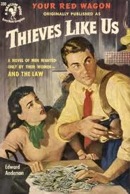
Book: Thieves Like Us... Background: Born 1905 in Weatherford, TX... Journalist? Naturally. On staff of Rocky Mountain News, Los Angeles Examiner, Sacramento Bee, Fort Worth Star-Telegram... Military: None... Other Jobs: Radio writer, screenwriter, freight-hopping hobo... Married: Three times, twice to the same woman... Politics: Extreme right-wing views, informed somehow by his Swedenborgianism... Alcoholic? Yes, which might partly explain his recurrent transient's life...What else should we know? Thieves Like Us made into two classic films, by Nicholas Ray (as They Live by Night) and Robert Altman, but Anderson didn't benefit much, having sold the film rights for a quick $500. There are eight Edward Andersons with a Wikipedia entry; this Edward Anderson isn't one of them. Talk about sinking like a stone.
KENNETH FEARING
Book: The Big Clock... Background: Born 1902 in Oak Park, IL... Journalist? Reviewer for the New Yorker, later in life a Newsweek staffer... Military: None... Other jobs: Nothing of note; all he did was write, including several volumes of poetry... Married: Twice, both ending in divorce... Politics: Investigated by the FBI for being a communist... Alcoholic? Yes, and died in poverty at age 59... What else should we know? The Big Clock made into a film in 1948, but Fearing made little money from it. Also the basis of the 1987 film No Way Out.
WILLIAM LINDSAY GRESHAM
Book: Nightmare Alley... Background: Born 1909 in Baltimore, MD... Journalist? Book reviewer for Evening Post (New York) and crime magazine editor... Military: Medic with the Lincoln Brigade in Spain... Other jobs: Greenwich Village folk singer, copywriter... Married: Three times. He and second wife, poet Joy Davidman, deeply influenced by ideas of C. S. Lewis, although Gresham eventually drifted away from Christianity, dabbling in Zen Buddhism and Scientology. Following his divorce from Davidman, he married her cousin, while Davidman married C. S. Lewis... Politics: Member of Communist Party... Alcoholic? Yes, and sometimes made him violent... What else should we know? Committed suicide with overdose of sleeping pills after registering in New York hotel under false name. He was 53.
CORNELL WOOLRICH (aka William Irish)
Book: I Married a Dead Man... Background: Born 1903 in New York City... Journalist? Never... Military: Nope... Other jobs: None... Married: Married for three months to daughter of filmmaker J. Stuart Blackton, after which he traveled through Europe with his mother and then moved into her Upper West Side apartment, where he remained for the next 25 years. Woolrich, if you haven't guessed already, was very gay... Alcoholic? Yes, which contributed to drastic slowdown in productivity and two decades as a recluse... What else should we know? The good: Also the author of Rear Window (filmed by Alfred Hitchcock) and The Bride Wore Black (filmed by Francois Truffaut). The bad: in 1961, two years after death of mother, his gangrenous leg had to be amputated; he died of a stroke ten months later at the age of 58.
Sunday, July 3, 2011
Hey everybody, meet my new friend--Philomena Joy
Email I received earlier today...
SUBJECT: Hello
Hello my name is philomena joy, i am interested in you for good relationship, if you feel the same you can as well contact me at [no link] for a better introduction.
Thanks
philomena joy
Thursday, November 4, 2010
Your building's on fire. You're exhausted. Luckily Björk is here

Although I'm very fond of Björk, and firmly in awe of her artistry, I've always found her about as sexy as Tinkerbell. The corkscrew hairdos and floppy swan outfits and the chin resting on the limp wrists, fingertips waving—I appreciate them all as theater, but they kind of disqualify her as crush material. But the photo above opens up other possibilities—possibilities that, as I'll explain farther down, have been there all along. Of course, I realize that the nude and natural Björk in this shot is as much a mask as this, or even this. But she inhabits it expertly, right down to the tongue and the laugh, which makes me think Björk—unlike that robot Madonna—is in on the secret, that the "big time sensuality" she sang about was real to her.
While she projects an image of a voracious, almost post-human creature out to consume the world (“I don’t know my future after this weekend, and I don’t want to!”), there is a tender, highly romantic strain in her work. She falls in love, which sounds like a simplistic statement, I know, but not everybody does. She gets weak in the knees; she crumbles—“unravels,” as one song has it. Her songs dwell in the fleeting but all-consuming stage when things get heavy. “Love is a two-way dream,” one of her songs goes.
My favorite Björk song in this mode is one of her least known. In “Come to Me” the love sounds unconditional; the only rule is to not talk about it—which means that the song, although addressed to another person, is never actually delivered to that person. Which brings up the weirdly lonely aspect of falling hard. It’s that extra dimension that gives Björk’s love songs their heft.
Every once in awhile I stumble upon some song that, even in the digital era of no unturned stones, has never been transcribed anywhere online—no chords, no tabs, nothing. You know what that means: I have to do it myself. (I also clean up the dirty dishes in my house that people leave lying around.) Playing this thing on guitar, I'm struck by the almost Spanish quality of its melody, something that doesn't come through at all in its rather spacey recording. I also have to confess to not knowing the name of the chord that comes after the second word in "You know that I adore you..." and has the effect of the floor suddenly dropping out from under you. You can just stay on the B-flat, that will "work," but I've found that lifting the finger off the first string creates a downshift essential to the tune.
And yet, I have no idea what the resulting chord is. I've looked everywhere for this chord, which in tabs would appear as 0333XX. I've asked no less than three of my more musicologically-astute friends what this chord could be, and they've told me it doesn't exist. I've tried to give it a name. But I've turned up nothing.
Come To Me
(Björk Guðmundsdóttir)
A--------------Bb
Come to me, I'll take care of you
A-----------Bb
Protect you; calm, calm down
A--------------------Bb
You're exhausted; come lie down
A------------------------------Bb
You don't have to explain, I understand
Instrumental: A Bb A Bb
Bb---------B?-------Am
You know that I adore you
Am---Bb----------Am-----Cmaj7-----F
You know that I love you
Fmaj7--------------C
So don't make me say it
C--------------------Bb
It would burst the bubble
Bb---------E-----E7
Break the charm
Jump off—your building's on fire
And I'll catch you, I'll catch you
Destroy all that is keeping you down
And then I'll nurse you, I'll nurse you
I'll touch you
You know that I adore you
You know that I love you
So don't make me say it
It would burst the bubble
Break the charm
END
Subscribe to:
Posts (Atom)